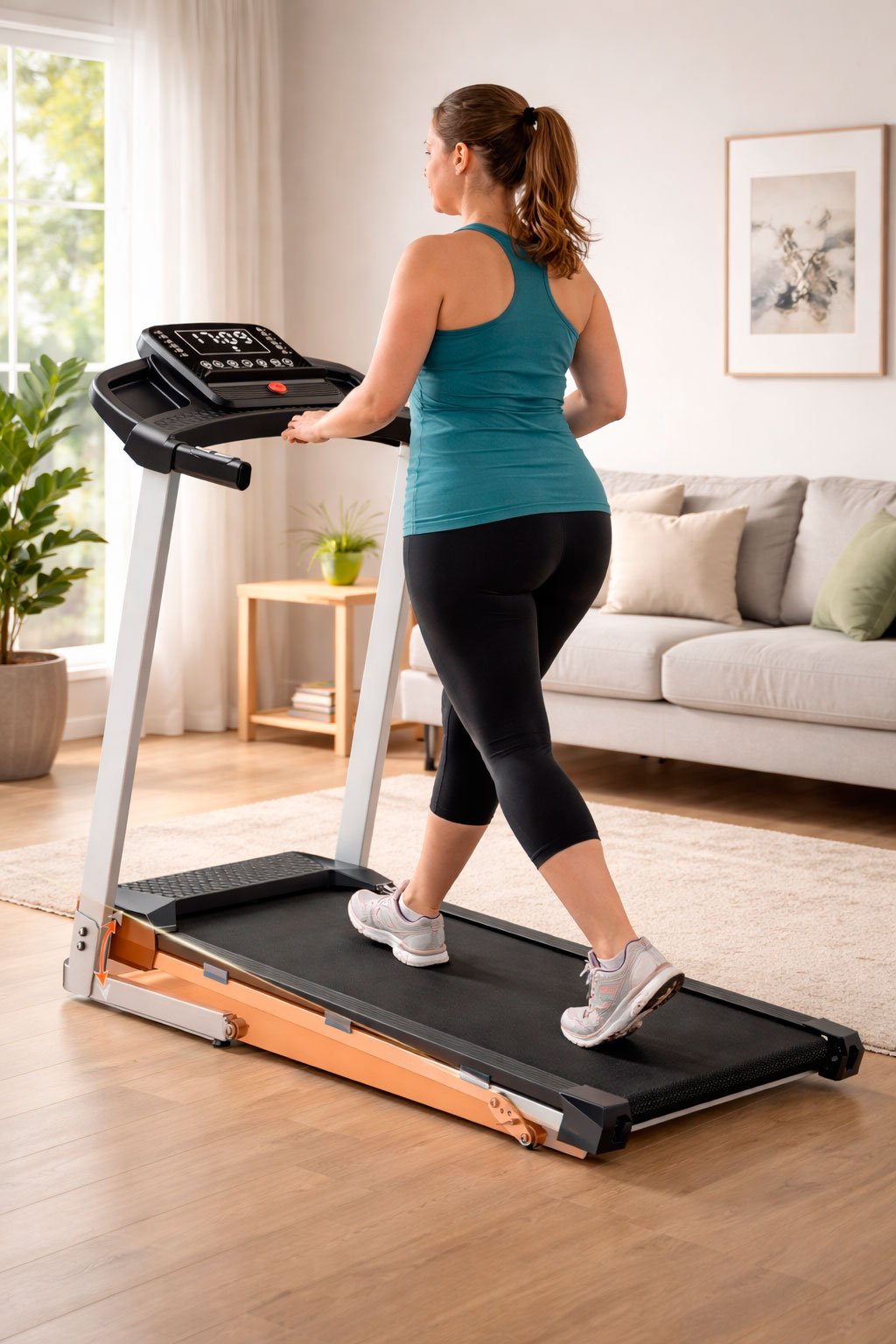
I work with people who train at home on compact treadmills: folding treadmills, incline walking pads, and desk treadmills. These machines are not gym monsters, but they are extremely effective for fat loss if you train correctly. Below is exactly how I structure training, with real numbers and realistic expectations.
I’ll refer to three common treadmill types people use today:
– classic foldable home treadmills (walking + light running)
– compact incline walking pads
– under-desk / 3-in-1 walking treadmills
The principles are the same. Only intensity and volume change.
First, a hard truth about fat loss
Fat loss is not about “burning fat workouts.”
It is about daily calorie deficit created by:
– movement you can repeat consistently
– recovery you can sustain
– intensity that does not destroy adherence
For 90% of my clients, walking-based treadmill training beats running for fat loss. Especially after 35–40 years old.

How I choose training intensity (very important)
I do not start with speed.
I start with heart rate and body weight.
This matters because the same speed means completely different load for different people. A 60-kg person walking at 3.5 mph and a 100-kg person at the same speed are not doing the same workout metabolically.
Rule of thumb I use:
– Fat loss zone: 60–70% of maximum heart rate
– For most people: brisk walking, not running
In practice, this usually means you should be able to:
– breathe faster but still talk in short sentences
– maintain the pace for 30–60 minutes
– finish the session tired but not exhausted
Why brisk walking beats running for fat loss
Running pushes many people above the fat-oxidation zone very quickly. Appetite rises, joints suffer, recovery slows, and consistency drops. Brisk walking keeps people in a zone they can repeat day after day. Weekly volume wins.
This is exactly where incline walking and compact treadmills shine.
Which treadmill types work best for this approach
Incline walking treadmills (manual or motor incline)
Best choice for structured fat-loss sessions.
Why they work:
– incline raises heart rate without increasing impact
– walking mechanics stay stable
– calorie burn rises without joint stress
Typical setup I prescribe:
– speed: 3.0–3.8 mph
– incline: 4–7%
– duration: 40–60 minutes
Who they suit:
– users over 35–40
– people with knee sensitivity
– anyone focused on sustainable weight loss
Examples include compact incline walking treadmills and foldable home treadmills with basic incline functions.
Compact foldable home treadmills (walking + light jogging)
Good all-round option if space is limited but you want flexibility.
How I use them:
– fat loss sessions are still walking-based
– jogging is optional, not required
– incline walking remains the core tool
Best for:
– users who want “real workouts” at home
– people who may jog occasionally but don’t rely on it for fat loss
These are closest to entry-level home treadmills from mainstream fitness brands.
Walking pads with incline
Surprisingly effective for fat loss if programmed correctly.
Key advantage:
– forces discipline: walking only
– very easy on joints
– high adherence
Training style:
– slightly longer sessions (45–75 minutes)
– consistent weekly volume
– no temptation to run
These are ideal for people who:
– dislike running
– want simple, repeatable training
– prefer quiet, low-impact workouts
Desk treadmills and 3-in-1 walking treadmills
Excellent for increasing total daily energy expenditure, not for “workouts” alone.
How I use them:
– low-speed walking during work (1.0–1.8 mph)
– separate short training walks at higher pace
– combined effect is powerful over time
They shine when:
– sitting time is very high
– formal workouts are hard to schedule
– recovery and joints are a priority
Important limitation:
– they support fat loss through volume, not intensity
What I generally avoid recommending for fat loss beginners
– running-only treadmills without incline
– aggressive HIIT plans on treadmills
– sprint-based programs for overweight users
These tools are not bad, but they solve a different problem. Fat loss needs repeatability more than intensity.
The practical takeaway
If your treadmill allows you to:
– walk briskly
– add incline
– train 4–6 times per week without pain
…it is already a perfect fat-loss machine.
I choose the treadmill type last.
I choose heart rate, recovery, and consistency first.
Example client #1 (typical case)
Male
Age: 42
Height: 178 cm (5’10”)
Weight: 96 kg (212 lbs)
Target: lose 6–8 kg (13–18 lbs)
Walking parameters I prescribe:
– Speed: 3.2–3.6 mph
– Incline: 4–6% (manual incline is enough)
– Duration: 45 minutes
– Frequency: 5 sessions per week
Calorie burn (realistic, not fitness-tracker fantasy):
≈ 380–450 kcal per session
Weekly deficit from training alone:
≈ 1900–2250 kcal
Monthly fat loss from walking only:
≈ 1.0–1.3 kg (2.2–2.8 lbs)
Add basic nutrition control (nothing extreme):
– remove liquid calories
– reduce evening snacks
Total realistic fat loss:
≈ 2.5–3.5 kg per month (5.5–7.7 lbs)
This is sustainable. This is how people actually keep weight off.
Example client #2 (desk treadmill user)
Female
Age: 51
Height: 165 cm (5’5″)
Weight: 78 kg (172 lbs)
Equipment: 3-in-1 desk treadmill
Goal: reduce weight and joint stiffness
Daily work walking:
– Speed: 1.2–1.6 mph
– Duration: 90 minutes total (split into blocks)
Dedicated training:
– Speed: 2.8–3.2 mph
– Incline: 0–5%
– Duration: 30 minutes
– Frequency: 4 times per week
Calorie burn:
– Work walking: ≈ 180–220 kcal/day
– Training walking: ≈ 250–300 kcal/session
Monthly effect without stress:
≈ 1.8–2.5 kg fat loss
Key point: no fatigue, no knee pain, no burnout.
Why incline walking beats running for most people
Running burns more calories per minute.
But it also:
– increases injury risk
– increases hunger
– increases dropout rate
Incline walking:
– loads large muscle groups
– keeps heart rate in fat-oxidation range
– allows higher weekly volume
Fat loss is about weekly totals, not heroic sessions.
How I structure a week (simple and boring on purpose)
For classic folding treadmills:
– 3 days incline walking (45–60 min)
– 1 optional easy jog day (20–30 min)
– 1 long walk day (60–75 min, flat)
For compact incline walking pads:
– 4–5 walking sessions
– mix flat + incline days
– no running, no jumping
For desk treadmills:
– daily low-speed walking
– 3–4 short focused training walks
Consistency beats intensity every time.
Trendy training styles: what works, what doesn’t
Currently useful:
– incline steady-state walking
– zone-2 cardio (finally understood correctly)
– low-impact high-volume training
– daily movement accumulation
Overhyped or declining:
– extreme HIIT for fat loss
– “10-minute miracle” workouts
– fasted cardio marketing myths
– running-only fat loss plans for beginners
Why trends shift:
People are tired of injury, fatigue, and rebound weight gain. Walking works because humans evolved to do it for hours.
My rules for people over 40 (non-negotiable)
– No pain tolerated in knees or lower back
– Progress volume before speed
– Incline before running
– Minimum 8–10k steps per day total
– Sleep matters more than another workout
Final advice from practice, not theory
If you own a compact treadmill, you already have everything needed to lose weight. You don’t need harder workouts. You need more repeatable ones.
I’ve seen more long-term fat loss from people walking correctly on small treadmills than from people destroying themselves on full-size machines.
Walk more. Walk smarter. Stay consistent.
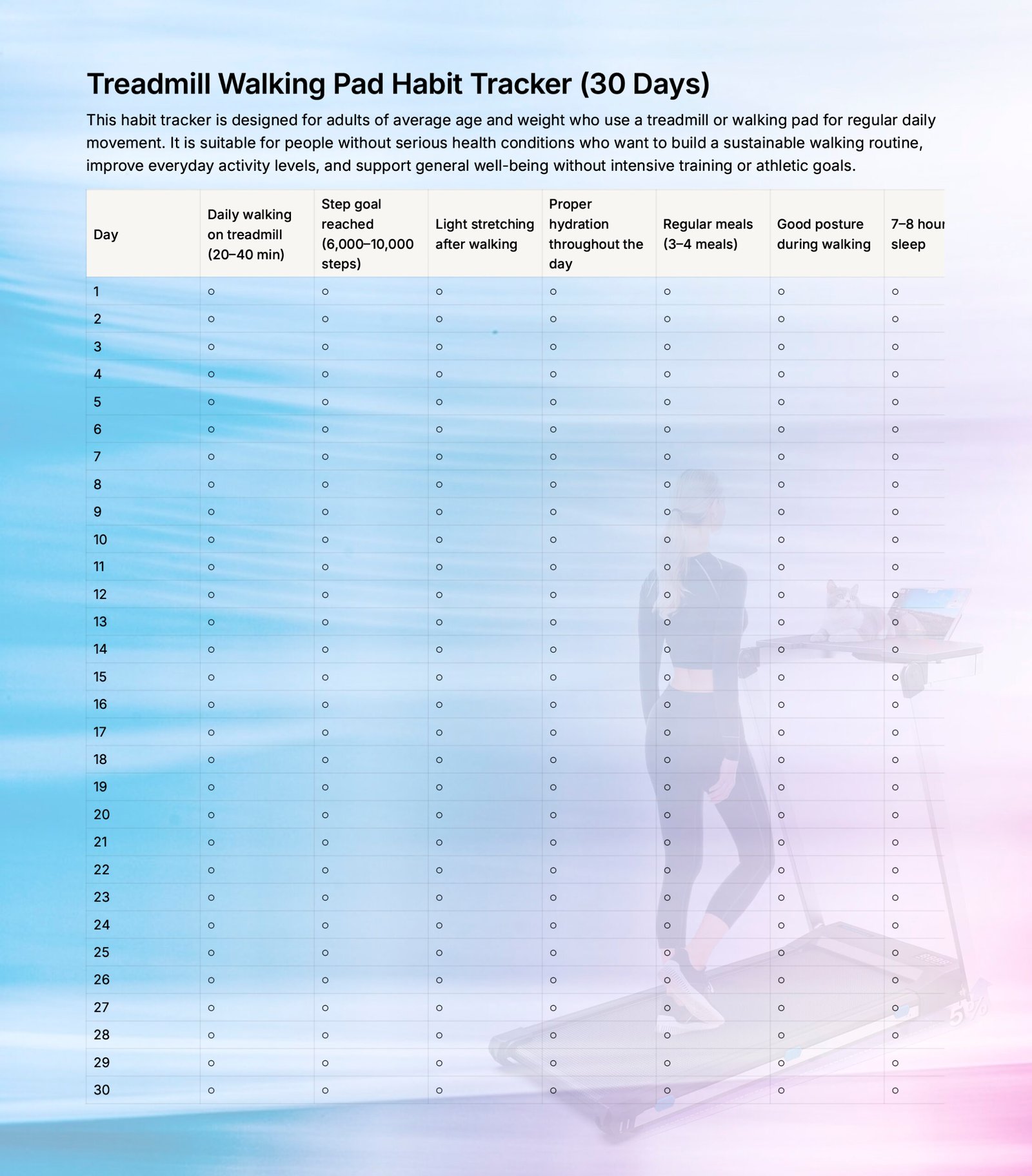
Bonus! Treadmill Walking Pad Habit Tracker (30 Days)
This habit tracker is designed for building a sustainable walking routine, improve everyday activity levels, and support general well-being without intensive training or athletic goals.