
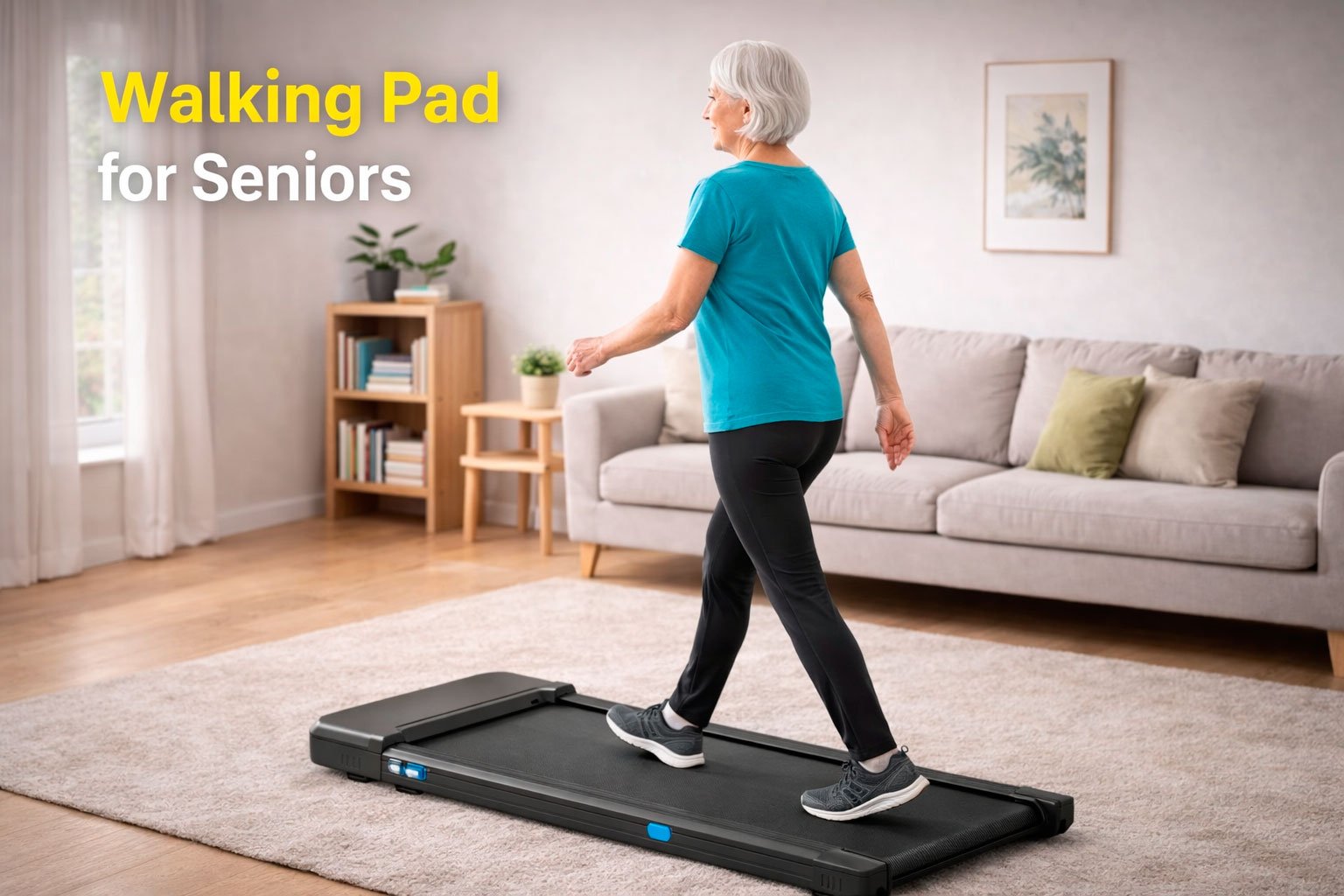
This Cardirun model is especially well suited for older adults who want to stay active safely at home. It combines a compact footprint, supportive handle bar, and simple controls with enough motor power to feel stable and confident underfoot. Rounded edges, a low step-up height, and quiet operation make it non-intimidating — which matters a lot for seniors starting or restarting regular movement.
Unlike large treadmills, this walking pad doesn’t dominate a room or require technical setup. It arrives ready to use, folds flat for storage, and can be placed where daily walking feels natural rather than forced. For many retirees, that practicality is what makes consistent exercise possible.
Why This Model Works Well for Seniors
Several design choices make this treadmill age-friendly by default.
The handle bar provides balance support during walking, speed changes, or light incline sessions. The belt size is generous enough for natural strides but not so wide that it encourages over-striding. Shock absorption reduces stress on knees, hips, and lower back, which is crucial for people with joint sensitivity.
Speed starts as low as 0.6 mph, allowing very gentle walking. The 5% incline is optional and manual, so users stay fully in control. App support and remote control reduce the need to bend down or interact with small buttons.

Who This Treadmill Is Best For
This model is suitable for a wide range of older users, with some practical guidelines.
Age range: typically 60–80+, depending on general health
Height: comfortable for users from about 150–185 cm (4’11”–6’1”)
Weight: up to 145 kg / 320 lbs
Gender: equally suitable for men and women
It’s especially appropriate for people with:
– mild knee or hip osteoarthritis
– controlled high blood pressure
– balance insecurity or fear of falling
– reduced outdoor walking due to weather or safety concerns
It is not designed for running or rehabilitation immediately after surgery without medical approval.
Recommended Training Formats for Older Adults
Below are simple, safe walking routines tailored for seniors. These are general guidelines, not medical prescriptions.
Gentle Daily Walk (Beginners or 70+)
Speed: 0.6–1.2 mph
Time: 10–20 minutes
Incline: 0%
Frequency: daily or every other day
This is where most people should start.
At 0.6–1.2 mph, walking remains fully controlled. You can hold the handle bar lightly, breathe through your nose, and maintain a conversation without strain. This pace keeps heart rate in a low aerobic zone, typically 40–55% of estimated max heart rate for seniors.
Physiological effect:
– improves blood circulation in lower limbs
– reduces morning stiffness in knees and hips
– gently activates ankle and hip stabilisers
Typical use case:
– people 70+
– people returning after long inactivity
– arthritis, joint stiffness, balance anxiety
Quote from my practice:
“I tell my older clients: if you finish a walk feeling like you could do five more minutes, that’s perfect. Feeling destroyed means we overshot.”
This format is about habit formation. Consistency matters more than intensity here.
Steady Health Walk (Active Seniors)
Speed: 1.5–2.5 mph
Time: 20–30 minutes
Incline: 0–3%
Frequency: 4–5 times per week
This is the most universal and sustainable format.
At 1.5–2.5 mph, most seniors reach a moderate aerobic zone. Heart rate usually sits around 55–70% of max, which is where cardiovascular benefits are strongest without excessive fatigue.
Physiological effect:
– improves cardiac output and oxygen delivery
– supports blood pressure regulation
– maintains muscle tone in calves, thighs, and glutes
Incline use:
A mild 1–3% incline increases energy expenditure by roughly 10–25% compared to flat walking, without needing higher speed. This is safer for joints than trying to “walk faster”.
Typical use case:
– adults 60–75
– people already walking outdoors
– those aiming to maintain weight and stamina
Practical advice:
Start flat for the first 5–10 minutes. Add incline only when breathing is steady and posture feels relaxed.
Bone & Balance Support Walk
Speed: 1.8–2.2 mph
Time: 15–25 minutes
Incline: short intervals at 3–5%
This format targets strength and balance, not cardio alone.
Short incline intervals slightly increase ground reaction forces and muscle engagement. This helps stimulate bone density and improves neuromuscular coordination — both important for fall prevention.
Physiological effect:
– strengthens hip stabilisers and quadriceps
– improves ankle proprioception
– supports posture and spinal alignment
How to structure it:
– 5 minutes flat
– 2–3 minutes incline at 3–5%
– 3–5 minutes flat
Repeat once or twice.
Typical use case:
– people concerned about balance
– history of minor falls
– early-stage osteoporosis (with doctor approval)
Important:
Incline should feel “challenging but controlled”. If grip tightens or steps shorten noticeably, reduce incline.
Weight & Blood Sugar Control Walk
Speed: 2.0–3.0 mph (as tolerated)
Time: ~30 minutes
Incline: optional light incline
This format is useful for metabolic health.
Walking at this pace increases glucose uptake by skeletal muscles, improving insulin sensitivity. Studies show that 30 minutes of moderate walking can reduce post-meal blood glucose spikes by 20–30% in older adults.
Physiological effect:
– improves glucose regulation
– increases calorie expenditure
– supports fat metabolism
Best timing:
– 30–60 minutes after meals
– late morning or early evening
Typical use case:
– type 2 diabetes or prediabetes
– weight management goals
– metabolic syndrome (with medical clearance)
Quote from experience:
“For blood sugar control, timing matters more than speed. A calm 30-minute walk after dinner often works better than a harder session once a week.”
Progression Rule (Most Important Part)
Always start flat.
Increase speed or incline slowly.
Think in weeks, not days.
A safe progression looks like:
– first 2 weeks: flat walking only
– weeks 3–4: add mild incline or +0.2 mph
– reassess comfort before any further increase
If joint pain lasts more than 24 hours, the workload was too high.
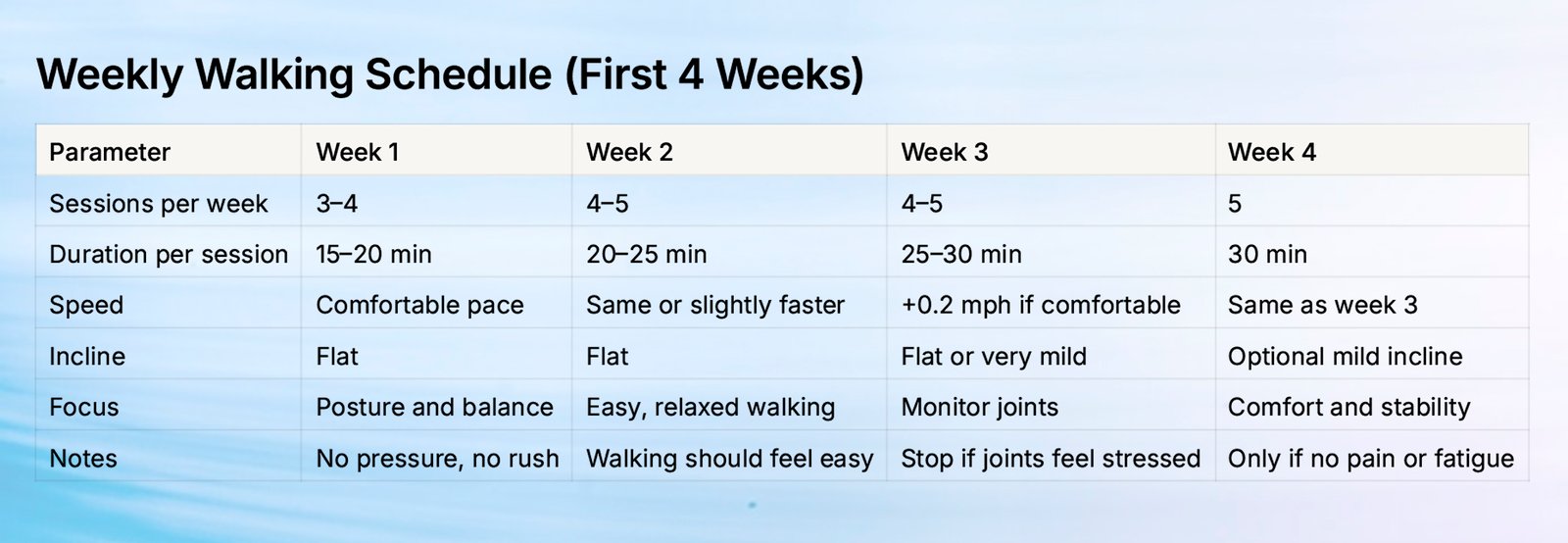
Bonus! Safe Walking Schedule for Seniors (Beginner-Friendly)
This walking schedule is designed for older adults who use a treadmill or walking pad for health, mobility, and daily activity. It focuses on safety, consistency, and gradual progression without stress on joints or the cardiovascular system.
Common Mistakes Seniors Should Avoid — and why they matter
Below are the most frequent issues I see in real life. Not theory — patterns that repeat with clients, neighbours, and even my own family members.
I’ll explain what goes wrong, why it happens, and how to avoid it calmly and safely.
Walking too fast, too soon
This is the number one mistake.
Many seniors assume that faster equals better. In reality, speed that exceeds your current balance and endurance increases fall risk and joint strain without adding meaningful health benefits.
What actually happens:
– stride shortens
– posture collapses forward
– heel strike becomes unstable
Studies show that walking speed above a comfortable pace does not significantly increase cardiovascular benefit for older adults unless endurance has already been built gradually.
From my experience:
“I often tell clients: if you need to concentrate hard just to keep up, you’re already past the useful zone. Walking should feel automatic, not stressful.”
Fix:
Start at a pace where breathing is calm and steps feel repeatable. Progress in small increments over weeks, not days.
Skipping the handle bar when balance is uncertain
Some people avoid using the handle bar because they think it means weakness. That mindset causes unnecessary risk.
The handle bar is not a crutch — it’s a stability tool.
Why it matters:
– even light fingertip contact improves balance feedback
– reduces fear response and muscle tension
– lowers fall risk during speed changes
Research on gait stability shows that light touch support can reduce postural sway by up to 20–30% in older adults.
Real example:
A client refused the handle bar at first. After one near-slip, we reintroduced it gently. Within a week, confidence improved and walking sessions became longer and calmer.
Fix:
Use the handle bar until balance feels automatic. There is no prize for not using it.
Using incline before building endurance
Incline looks harmless, but it multiplies load.
A 5% incline can increase joint and muscle demand by 30–50% compared to flat walking. That’s significant for knees, hips, and Achilles tendons.
Common outcome:
– knee soreness after sessions
– calf tightness
– reduced walking frequency due to discomfort
From practice:
“Incline is a spice, not the base. Add it only after flat walking feels boring — not exhausting.”
Fix:
Spend at least 2–3 weeks on flat walking first. Introduce incline in short intervals only.
Walking in unsupportive shoes
This issue is underestimated.
Soft slippers, worn sneakers, or smooth soles reduce ground feedback and increase slip risk on treadmill belts.
What good shoes provide:
– stable heel cup
– non-slip sole
– moderate cushioning without excessive softness
Clinical gait analysis shows that footwear stability directly affects step consistency and balance control in older adults.
Practical rule:
If you wouldn’t feel safe walking briskly on a sidewalk in those shoes, don’t use them on a treadmill.
Treating smartwatch or app data as medical diagnosis
This is increasingly common.
Heart rate spikes, sleep scores, or “stress alerts” can cause unnecessary worry. Consumer devices estimate trends — they do not diagnose conditions.
What these tools are good for:
– noticing patterns over time
– supporting motivation
– tracking consistency
What they are not:
– medical-grade diagnostics
– replacements for doctor advice
My personal stance:
“I like apps when they reassure and motivate. The moment they create anxiety, they’ve crossed the line.”
Fix:
Use data as feedback, not judgment. If something feels wrong physically, trust your body and consult a professional.
App Use: Helpful, Not Mandatory
Apps can be helpful for older adults, but they should never feel mandatory. The best apps for seniors are quiet, supportive, and easy to ignore when needed. They work in the background and help build confidence rather than pressure.
Apple Health is one of the most senior-friendly options, even though it is not designed specifically for older users. It focuses on long-term trends instead of daily performance. Steps, walking distance, and heart rate are shown over weeks and months, which helps people notice steady improvement without feeling judged. Many older users feel more comfortable with Apple Health because it does not constantly push goals or send aggressive reminders.
Google Fit works in a similar way on Android devices. Its main strength is simplicity. The app highlights basic movement and heart-healthy activity rather than workouts or athletic achievements. Short daily reminders are optional and gentle. For many seniors, Google Fit feels more like a daily log than a training program, which makes it easier to stick with.
Wellfit, which pairs with many walking pads and treadmills, is practical for seniors who want structure without complexity. It shows time, distance, speed, and calories in a clear layout. There is no pressure to compete or improve rapidly. From my experience, people in their 60s and 70s like Wellfit because it confirms that they are moving regularly, not because it pushes them to do more.
Kinomap can be useful for a specific type of older user. It turns walking into a visual experience by showing real routes and landscapes. For people who feel bored or disconnected while walking indoors, this can make sessions more enjoyable. It works best at slow and moderate speeds and is more about motivation than data accuracy.
Some seniors prefer extremely simple step-tracking apps such as Pacer. These apps count steps and show daily or weekly totals without complex charts or health metrics. This approach is often ideal for beginners or for people returning to movement after a long break.
From my perspective, the most important rule is this: apps should support a routine, not control it. I often tell clients that if an app makes them feel anxious, guilty, or rushed, it is not doing its job. A good app for older adults should confirm progress, not evaluate it. Walking is about consistency and comfort, not scores or rankings.
In practice, many seniors use apps only a few times a week, or even just to check trends once a month. That is perfectly fine. The treadmill or walking pad should remain the main tool. Apps are optional helpers, not requirements for success.
The key advantage is choice. This treadmill works equally well with or without digital tools.
Final Perspective
For retirees and older adults, this Cardirun walking pad hits an important balance. It is stable without being bulky, supportive without being complicated, and flexible without feeling fragile. Most importantly, it lowers the psychological barrier to movement.
For many seniors, the best treadmill is not the most powerful or the most advanced — it’s the one that feels safe, approachable, and easy to use every single day. This model fits that role very well.